
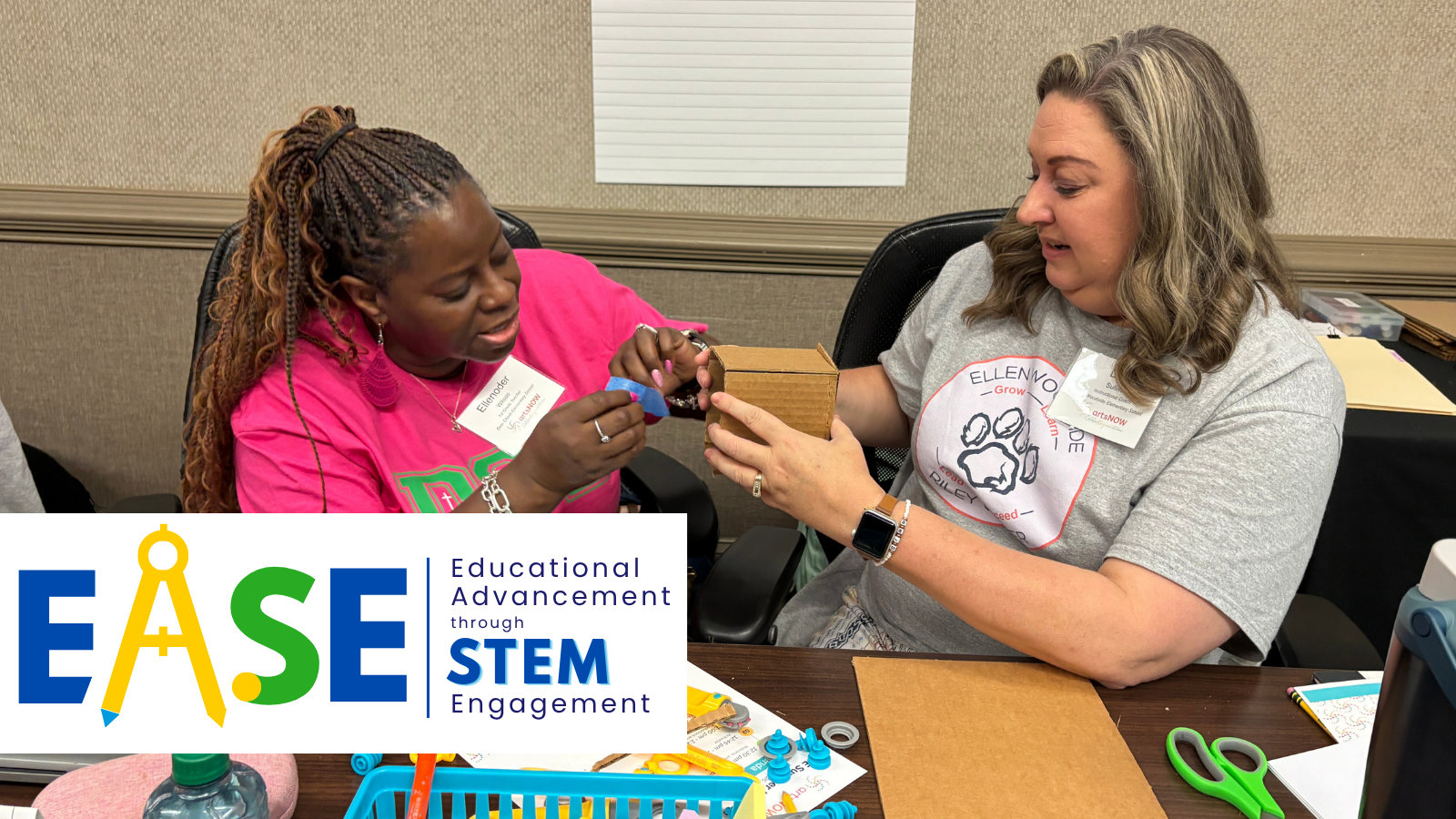
The 2025–26 school year marked an important year for Educational Advancement through STEM Engagement (EASE), a national initiative of Young Audiences Arts for Learning (YA), with two EASE schools building the foundations for sustained arts integration in math and science.
Throughout the academic year, YA Atlanta-based affiliate ArtsNOW led teachers in quarterly professional learning, while selected teacher leaders received virtual coaching. Teacher leaders also worked alongside ArtsNOW to develop and pilot arts-integrated math and science lessons, putting new strategies into practice in their own classrooms.
As part of the project’s ongoing evaluation, teacher leaders shared their experiences through semi-annual reflections and a spring focus group. Their feedback was overwhelmingly positive: all teacher leaders reported being highly satisfied with ArtsNOW's professional learning and coaching.
More importantly, teachers described meaningful changes in their classrooms. They highlighted increased student engagement, stronger content retention, and greater opportunities for students to demonstrate their understanding through the arts. They also reported greater enjoyment in their own teaching and learning as educators.
“One of the biggest strengths I’ve seen is increased student engagement. Students who are typically quieter or struggle with traditional tasks really shine when given opportunities to express their understanding through movement, visual art, or drama. I’ve also noticed improved retention of content. Students remember concepts better when they’ve experienced them in a hands-on, creative way. Teachers are also starting to see how arts integration can support differentiation, especially for English learners and students who need additional support.”
- EASE Teacher Leader
EASE's initial year offered valuable insight into what it takes to make arts integration a regular component of classroom instruction, and these lessons learned will help shape the next phase of EASE. Teacher leaders will play an important role in providing just-in-time support as teachers implement arts-integrated math and science lessons. Having teacher leaders at each grade level can also help schools welcome and support teachers who are new to the school or to arts integration.
Seven New Schools Join EASE
In summer 2026, EASE expanded to seven additional schools across three states, each beginning a three-year, job-embedded professional learning model focused on arts integration in math and science.
Each school sent a team of five teachers and its principal to ArtsNOW’s Foundational Seminar in June. The experience gave school teams an opportunity to learn alongside educators from across the region while developing practical strategies they could bring back to their classrooms.
These new EASE schools then launched the initiative in their own communities, with each district hosting a half-day kickoff event with its participating teachers to introduce the grant structure and begin planning for their arts-integrated learning journeys.
At the end of July, YA New Orleans-based affiliate Young Audiences of Louisiana hosted professional learning for 80 teachers, school leaders, and paraprofessionals, kicking off the first year of EASE implementation through arts integration.
ArtsNOW also hosted kickoff days in Greenville, South Carolina, and Augusta, Georgia, bringing together 245 preK–5 classroom teachers, instructional coaches, special education and ESOL teachers, paraprofessionals, and district and school administrators.
Participants reviewed the goals of EASE and rotated through breakout sessions led by arts consultants, where they experienced arts-integrated instructional strategies using music, visual art, drama, and movement. The response was encouraging: post-event surveys showed that participants valued the learning and were looking forward to applying what they had learned in their classrooms.
The early data also points to the importance of strong school leadership. 94% of participating math and science teachers agreed that their school leaders support teachers’ efforts to use arts integration, which is essential for sustaining successful implementation over time.
Teachers also identified arts integration as a meaningful source of engagement in their profession. 73% agreed that they were more likely to remain in teaching if they were able to use engaging arts-integrated strategies.
Looking Ahead
With the addition of these additional schools, EASE has entered an exciting new phase. Over the next three years, participating educators will continue to receive job-embedded professional learning and support as they integrate the arts into math and science classroom instruction.
The project will also provide an opportunity to study what difference arts integration can make for student learning. Each EASE school will be matched with a similar comparison school, and the evaluation team will collect student achievement data in math and science over the next three years, with 2026 serving as the baseline year. This approach will help the EASE team measure the added benefit of arts integration and better understand its impact on student achievement.
From the first two schools beginning their journey to seven new schools joining the initiative, EASE is building momentum for a more creative, engaging approach to STEM learning. As educators gain new tools, school leaders strengthen their support, and teacher leaders emerge as champions within their schools, EASE is laying the groundwork for arts integration to become a sustainable part of and successful tool for teaching and learning.
EASE is a five-year national initiative led by Young Audiences Arts for Learning in partnership with ArtsNOW and Young Audiences of Louisiana. Funded through an Early-Phase Education Innovation and Research (EIR) grant from the U.S. Department of Education, EASE will examine the feasibility and impact of arts-integrated STEM learning in K–5 classrooms. Learn more.
